 North Carolina

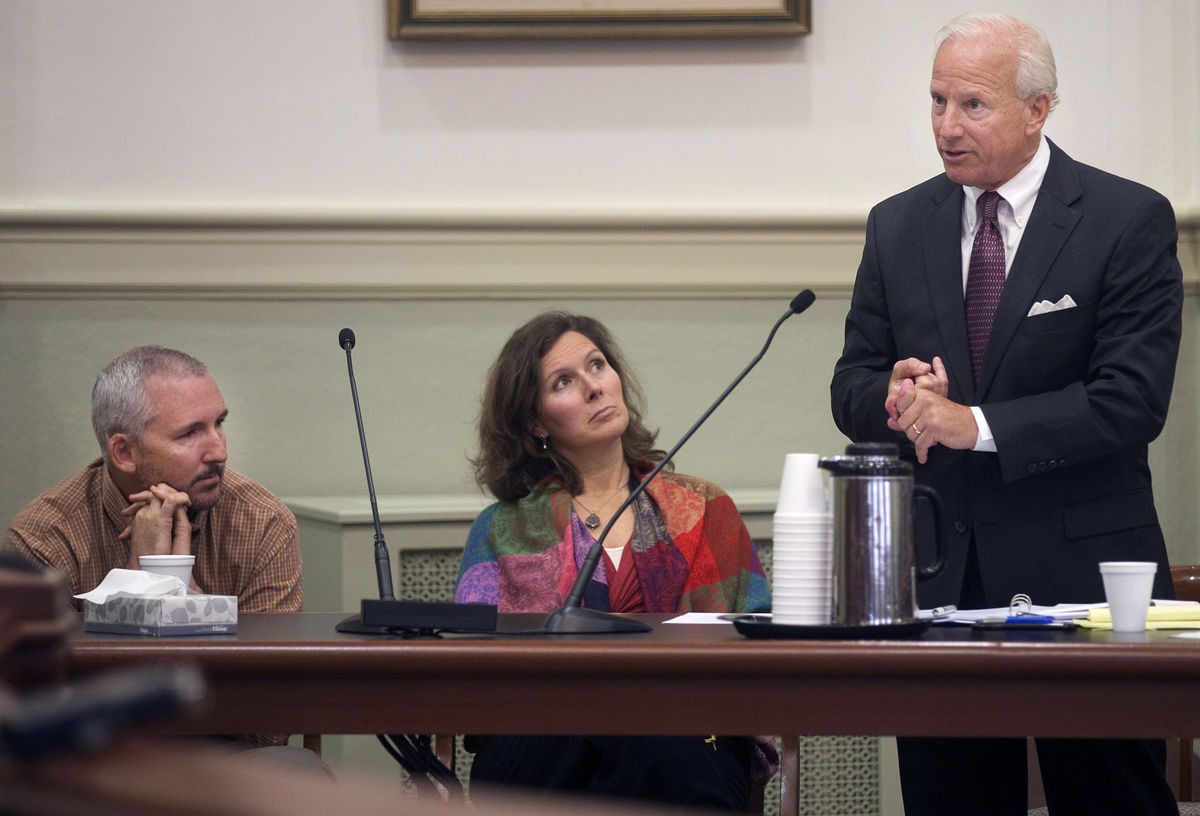
Original story: Judge’s Ruling Permits Pipeline Surveying of Franklin County Farm
By Duncan Adams
ROCKY MOUNT — The judge described Virginia’s pipeline surveying law as a “legislative failure.” He said Monday that he felt compelled to enforce it.
Judge Orders Franklin County Family Not to Interfere With Surveyors
The extended family that owns and operates Four Corners Farm in Franklin County repelled surveyors working for Mountain Valley Pipeline five times. It happened over about 13 months.
After a hearing Monday, Franklin County Circuit Court Judge William Alexander ordered the family not to interfere the next time surveyors come calling. That will likely happen over three days next week.
Alexander granted the injunction Mountain Valley sought to prohibit such interference. He said the pipeline company has a right to access the property under the Virginia law. The law allows surveyors working for natural gas companies to enter private property without permission. The company must first provide adequate notice as defined by the statute.
He said denying that statutory right would constitute irreparable harm to Mountain Valley. So would delays that might result from being unable to complete surveying.
Four Corners Farm and the Proposed Pipeline Route
Survey crews have been trying to access Four Corners Farm since May 2016. David and Betty Werner, their daughter, Carolyn Reilly, and her husband, Ian Reilly, own the farm. As Mountain Valley envisions it, the route for the controversial natural gas pipeline would burrow through a portion of the family’s 58-acre farm off Old Mill Creek Lane.
On Monday, after a hearing of more than two hours, Carolyn Reilly reacted to Alexander’s ruling. She noted that Mountain Valley had argued that delays could affect revenues, shippers of natural gas on the pipeline and the reputation of the companies in the $3.5 billion joint venture.
“The bottom line for me is that money talks,” she said. “It’s another win for money.”
Most recently, on June 1, the Werners and Reillys worked together to halt a crew of about 18 surveyors. The crew was attempting to enter their property near the confluence of Little and Teel creeks. The family stopped them until officers arrived from the Franklin County sheriff’s department.
After officers reached the scene, supervisors of the surveyors agreed to direct the crew to leave the property. They also agreed to seek a court order sanctioning access.
Judge Calls Virginia’s Survey Law a “Legislative Failure”
On Monday, Alexander granted that order. But he expressed ambivalence about the law.
“I think this whole statute is a legislative failure, frankly,” he said.
Lawmakers enacted the law in 2004. It has provoked bitter disputes between landowners and survey crews. The crews seek routes through Virginia for both the proposed Mountain Valley Pipeline and the separate but similar Atlantic Coast Pipeline. Each venture would begin in West Virginia and transport natural gas at high pressure through a 42-inch diameter buried pipeline.
Even though surveying continues, both projects say about 98 percent of that work in Virginia is complete.
The Mountain Valley Pipeline’s proposed path would travel through 11 counties in West Virginia and six in Virginia. It would terminate near Chatham at the Transco Pipeline. Seth Land, an attorney representing Mountain Valley at Monday’s hearing, noted that the pipeline could supply natural gas to Franklin County.
Like many landowners potentially affected by the project, the Reillys and Werners first learned about the pipeline in 2014.
In February, Bold Alliance hired Carolyn Reilly as a “pipeline fighter.” It tasked her with organizing opposition to both the Mountain Valley and Atlantic Coast projects.
Legal Challenges to the Surveying Law
Chuck Lollar is the Norfolk-based lawyer who represented the Reillys and Werners at Monday’s hearing. He has landowner clients living along the routes of both pipelines.
In August, he learned that the Virginia Supreme Court will hear his appeal of the state’s surveying law. He filed the appeal in May on behalf of property owners in Nelson County who had resisted surveying by crews working for Atlantic Coast.
Lollar’s appeal contends that the surveys Atlantic Coast Pipeline insisted upon were not necessary to meet regulatory requirements. He says that is one condition of the state law. And he argues that the law violates the Virginia Constitution, because surveys are an illegal taking of private property without compensation.
Justin Lugar, a lawyer in Roanoke, has challenged the survey law in a federal lawsuit. He filed it in Roanoke on behalf of 17 plaintiffs who own 10 properties along the proposed route of the Mountain Valley Pipeline. The lawsuit alleged that surveys of private property without an owner’s permission represent unconstitutional takings.
He also tackled larger issues.
FERC Approval and Eminent Domain
As interstate pipelines, both the Mountain Valley and Atlantic Coast projects need approval from the Federal Energy Regulatory Commission. If FERC approves the pipelines, each will have access to eminent domain to acquire easements across private properties.
Lugar argued in the lawsuit that FERC should not be able to grant the power of eminent domain to a private company for its pursuit of “private pecuniary gain.”
In a letter to the Reillys dated Sept. 6, Mountain Valley cited the potential for FERC to authorize eminent domain. The letter offered the family a one-time payment of more than $51,250 to obtain an easement across the farm. The company described the proposed payment as a final offer. It would withdraw the offer after Sept. 20.
Carolyn Reilly said Monday that the family will reject the offer.
Lollar told Alexander that Mountain Valley will not have the power of eminent domain unless FERC grants the certificate needed to proceed with construction. Surveying could be completed after certification, he said.
Testimony at the Franklin County Hearing
During testimony Monday, Ricky Myers, an engineering manager for EQT Corp., referenced certification. EQT is a major partner in the Mountain Valley project.
“We believe we are on track to get a certificate next week,” Myers said.
Robin Wall, an employee of Coates Field Service, testified during Monday’s hearing. She has helped coordinate surveying along the route of the Mountain Valley Pipeline. She said she had visited Carolyn Reilly’s Facebook page. There she saw that the family had previously invited “water protectors” to help them resist surveying.
After Monday’s hearing, Reilly said the family has a right to invite anyone to their farm.
Lollar Law represents property owners only, in Virginia, North Carolina and West Virginia. If surveyors want to enter your land, read about public utility takings or contact us at 757-644-4657.